Home › Free Tools › Randomness Audit
✨ 100% Free · No Sign-Up · Works on Any Device
Randomness Audit
Don’t just trust us – run up to a million simulated spins and check the results with real statistics.
Overview
Transparent, Testable Randomness
Every Spinpik wheel, dice roll and team split uses your browser’s cryptographically secure random number generator. This page lets you test that generator yourself, live on your own device.
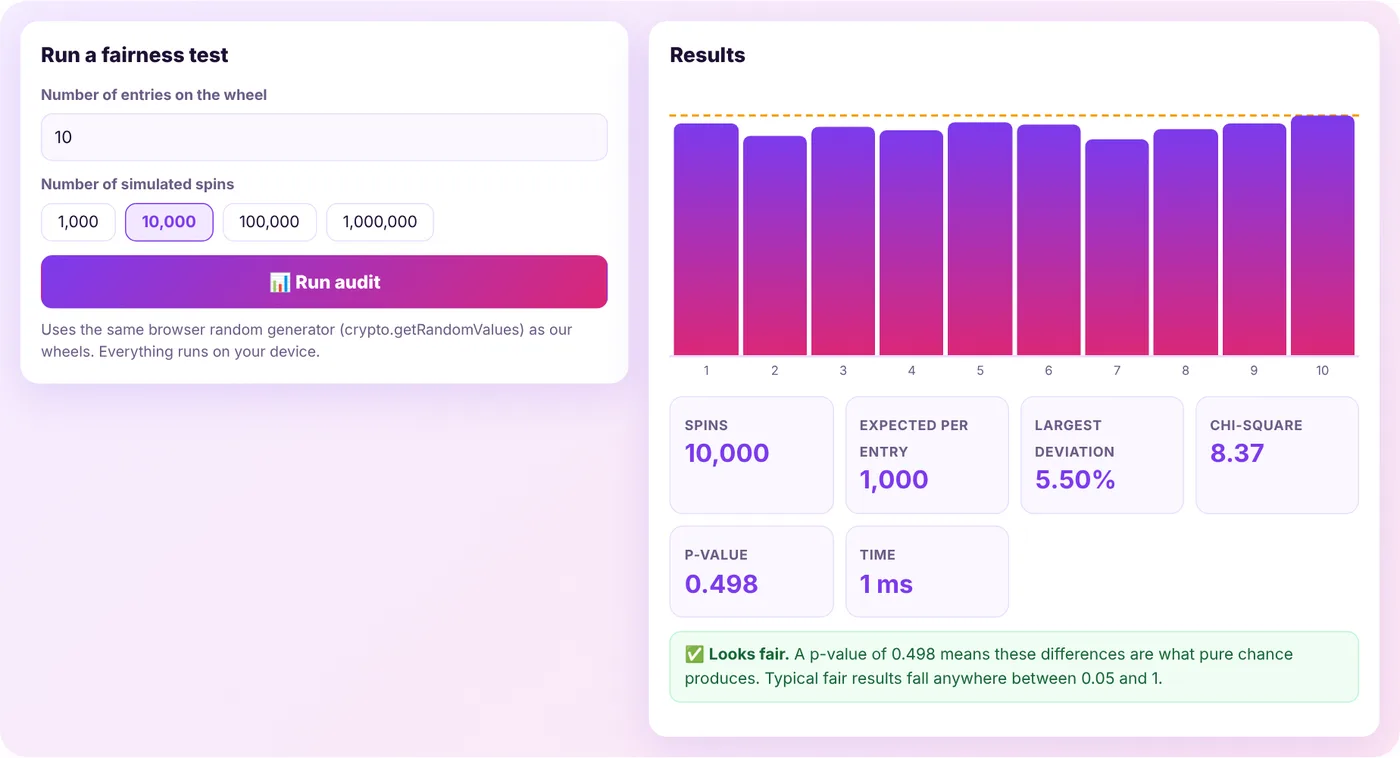
Choose how many entries are on the wheel and how many spins to simulate. The audit counts how often each entry wins, compares the counts to a perfectly even split and runs a chi-square test to tell you whether the differences are normal random variation.
Step by step
How the Audit Works
Step 1
Pick the number of wheel entries (2–50).
Step 2
Choose 1,000, 10,000, 100,000 or 1,000,000 simulated spins.
Step 3
Press Run audit – the test runs instantly in your browser.
Step 4
Compare each bar to the dashed “expected” line and read the p-value verdict.
Features
What We Measure
Plain-English statistics anyone can understand.
Win Counts
How many times each entry was selected.
Expected Line
The count every entry would get in a perfectly even world.
Largest Deviation
The biggest gap from expected, as a percentage.
Chi-Square Test
The standard statistical test for fairness across categories.
p-Value
How likely the result is under true randomness.
Same Engine
The audit uses the exact random source our tools use.
Use cases
Why It Matters
FAQ
Frequently Asked Questions
Keep exploring
More Free Tools
Convinced? Try the Real Thing
Spin a wheel with your own names, numbers or prizes.